Media Claims at Mid-Century
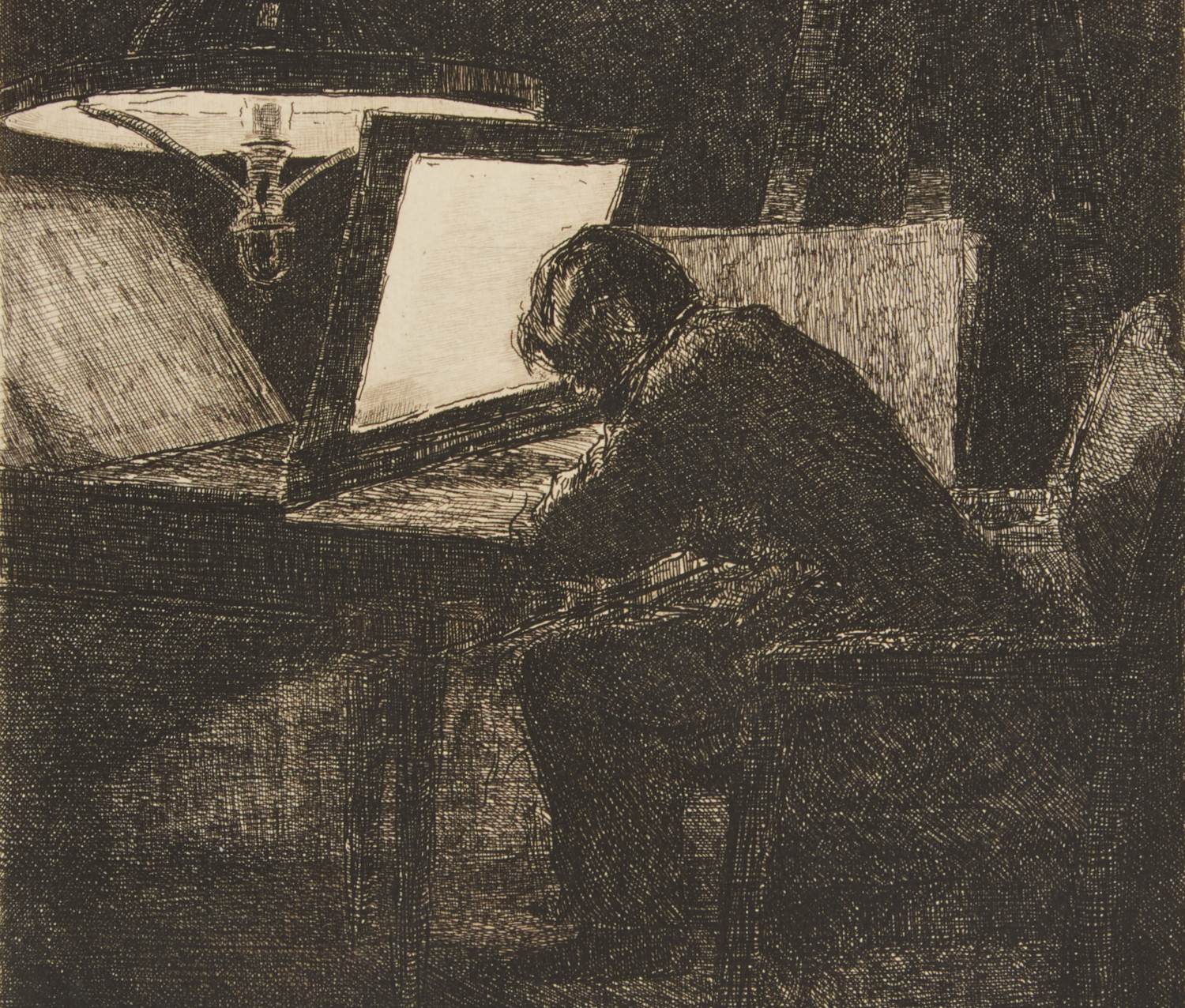 François Bonvin, The Printmaker (Le Graveur), 1861, etching and drypoint on laid paper. The Clark, 2024.6.4
The invention of photography in 1839 shifted the purposes and perceptions of older media, especially printmaking. Photography did not enjoy fine-art status in its first decades but won praise for its objectivity and accuracy. Consequently, printmaking’s ability to reproduce other art forms—and to precisely depict reality itself—came into question.
Early commentators on photography emphasized its mechanical qualities over its affective side. In response, etchers began to double down on their own medium’s authentic and personal qualities. Charles Baudelaire, for example, likened etched lines to handwriting that left a trace of the artist’s personality on the copperplate.
In the 1850s and 1860s, stakes were high for etchers to reclaim their status as creative artists through a focus on original compositions and exquisite printings. In 1862, the publisher Alfred Cadart and the printer Auguste Delâtre formed the Société des Aquafortistes (Society of Etchers), which went on to play an outsize role in promoting artistic etching.