

About the Exhibition
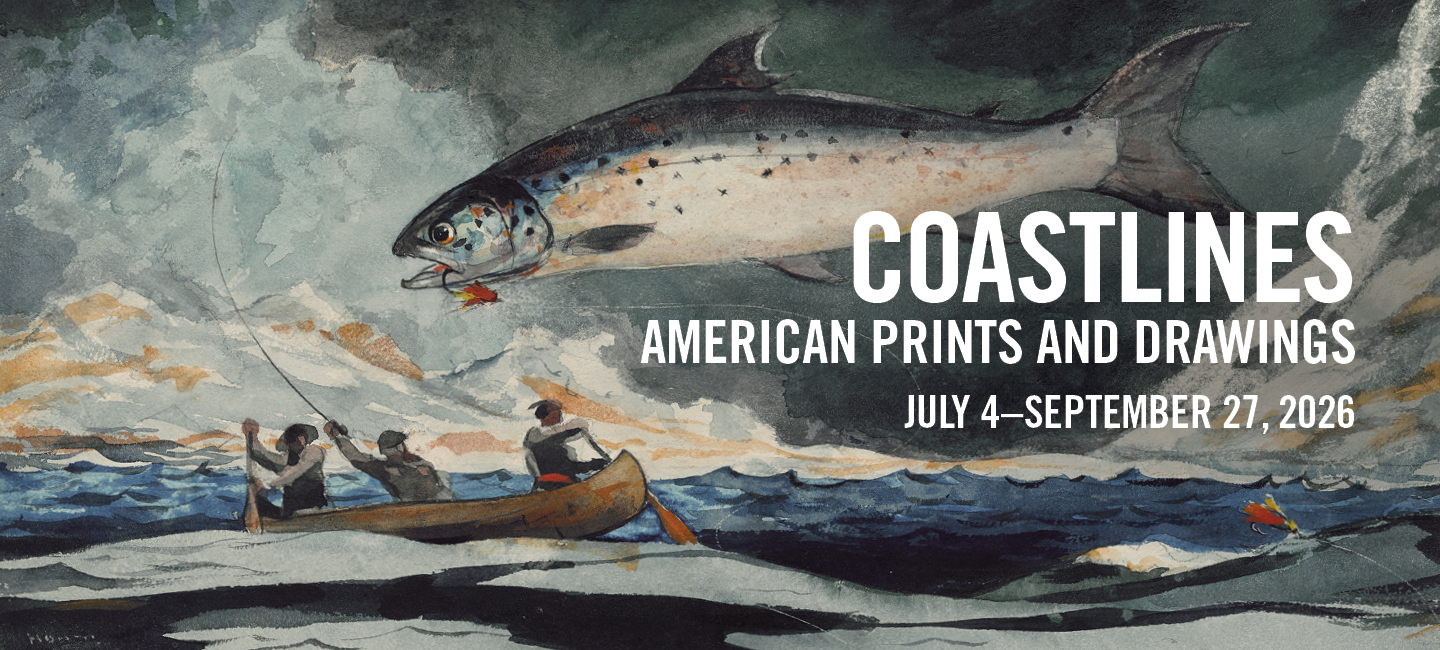
More than a landscape, the coastline is a site of labor, leisure, and national history. As the margin where the United States meets the Atlantic Ocean, the nation’s eastern coastline has fostered vital encounters where artists, coastal culture, and the natural world converge.
CoastLines: American Prints and Drawings draws almost entirely from the Clark’s own prints and drawings collection, bringing together a wide range of nineteenth- and twentieth-century representations of life along the shore. Focused on works by American artists depicting the eastern coast of the United States and their sojourns across the Atlantic, this exhibition explores the coastline as a site of contact and exchange, the stage for economic and cultural activity, and a terrain rich in American mythology.
These artistic representations of the coastline reveal the contradictions and complications of American identity. The eastern seaboard holds a layered national history: from Atlantic slave trade ports to the development of the nation’s early economy to the later emergence of leisure tourism and wilderness preservation. American artists along the coast grappled with these tensions, and their artistic experiments at the edge of the Atlantic created a distinctive national style with international influences, while drawing inspiration from both sensational popular media and lofty notions of the sublime.
CoastLines: American Prints and Drawings is organized by the Clark Art Institute and curated by Hannah Chew, Class of 2026, Williams College/Clark Graduate Program in the History of Art.
CoastLines: American Prints and Drawings is made possible by Chrystina and James R. Parks.