

Color and Photography Before 1960
RAP Graduate Student Symposium
April 10, 2026
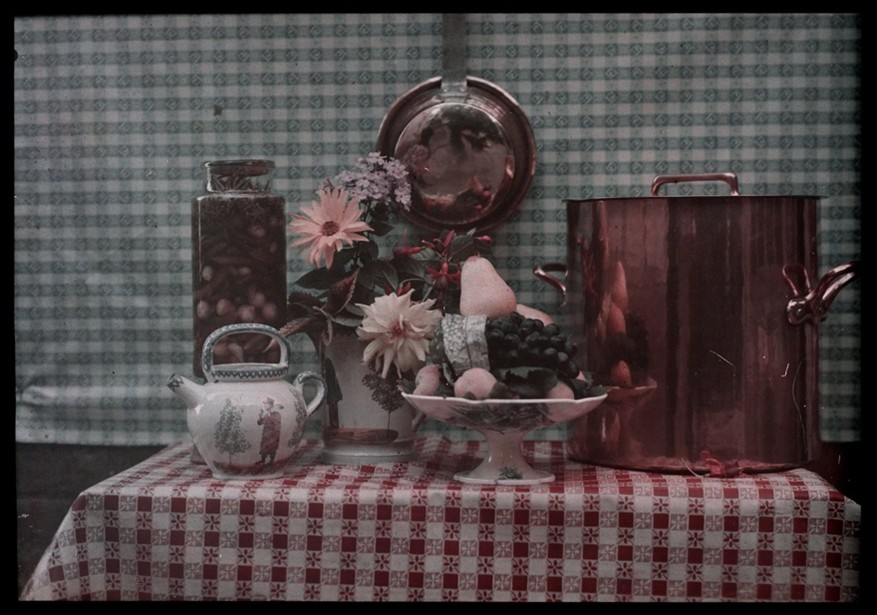
The Research and Academic Program (RAP) at the Clark Art Institute invited graduate students for a one-day symposium, “Color and Photography Before 1960,” held at the Clark in Williamstown, Massachusetts.
The Museum of Modern Art’s solo exhibitions of works by Ernst Haas (1962) and William Eggleston (1976) are often heralded as the moments at which color photography gained acceptance as art within the institution of the museum. However, whether in the form of pigment applied to a portrait, a question about translating a bright blue sky into a monochromatic landscape scene, or experimentation with subtractive and additive processes, color has played an integral role in photographic making since photography’s invention. Therefore, by the time audiences began to regularly see color and photographs together on museum walls, they held preconceptions about what the relationship between the two should look like, primed by decades of consuming intentionally toned black-and-white photographs as well as colorful images in magazines, films, photo albums, and more.
The aim of this symposium was to reflect on the developments—technological, aesthetic, psychological, and political—from 1839 to 1960 that defined the look, uses, and meanings of color(ed) photographs, broadly defined. Participants considered questions such as:
- To what extent can the subtractive and additive color processes that emerged around and after the turn of the twentieth century be seen as continuous with early practices of hand coloring or with the technologies of producing colored print media, and what complications might emerge from equating these processes?
- In what ways did the conventions of black and white photographs influence those of color photographs and vice versa, and how did photographers’ choice between the two come to take on political as well as aesthetic valences?
- How did emerging color photography technologies intersect with and shape contemporary understandings of racial, gender, and national identities and their expressions in visual culture?
- How was color photography instrumentalized by different political and cultural regimes, and how did the activities of these regimes shape the form of color photography that eventually took hold in the mass market?
- What lessons might be learned from exploring alternative histories of color photography, focusing on the techniques that never found widespread success?
- How does a retelling of the history of photography with a focus on color expand the canon of works and practitioners under scholarly inquiry?
The symposium was convened by Alexis Kelly (Williams Graduate Program in the History of Art, ’26) and organized by the Research and Academic Program.
The event concluded with a public keynote delivered by Rachel Lee Hutcheson (Visiting Assistant Professor, School of Arts and Sciences, Rochester Institute of Technology) on “Technical Difficulties: Early Color Photography and Conditioned Viewing."
Image: Unknown (French, 19th Century), Still Life with Copper Pots, c. 1910, Autochrome. Clark Art Institute, On loan from Hans P Kraus, Jr, for the Troob Family Foundation, TR TR2007.29.2.